Blog
Showing 1–12 of 22 posts
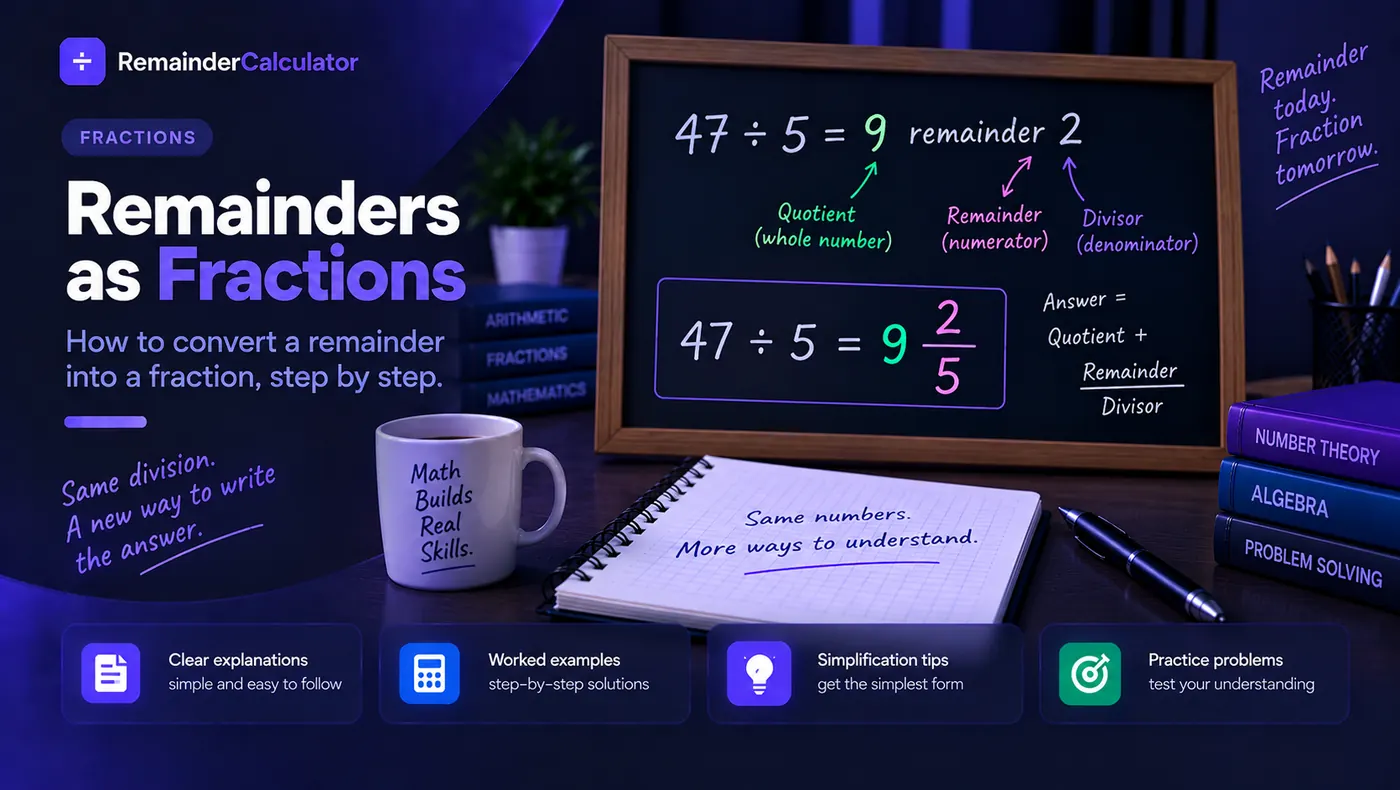
Remainders as Fractions: How to Convert a Remainder Into a Fraction
Turn a remainder into a fraction by writing it over the divisor. The mixed number rule, when to simplify, improper fractions and 10 practice questions with answers.
Read More →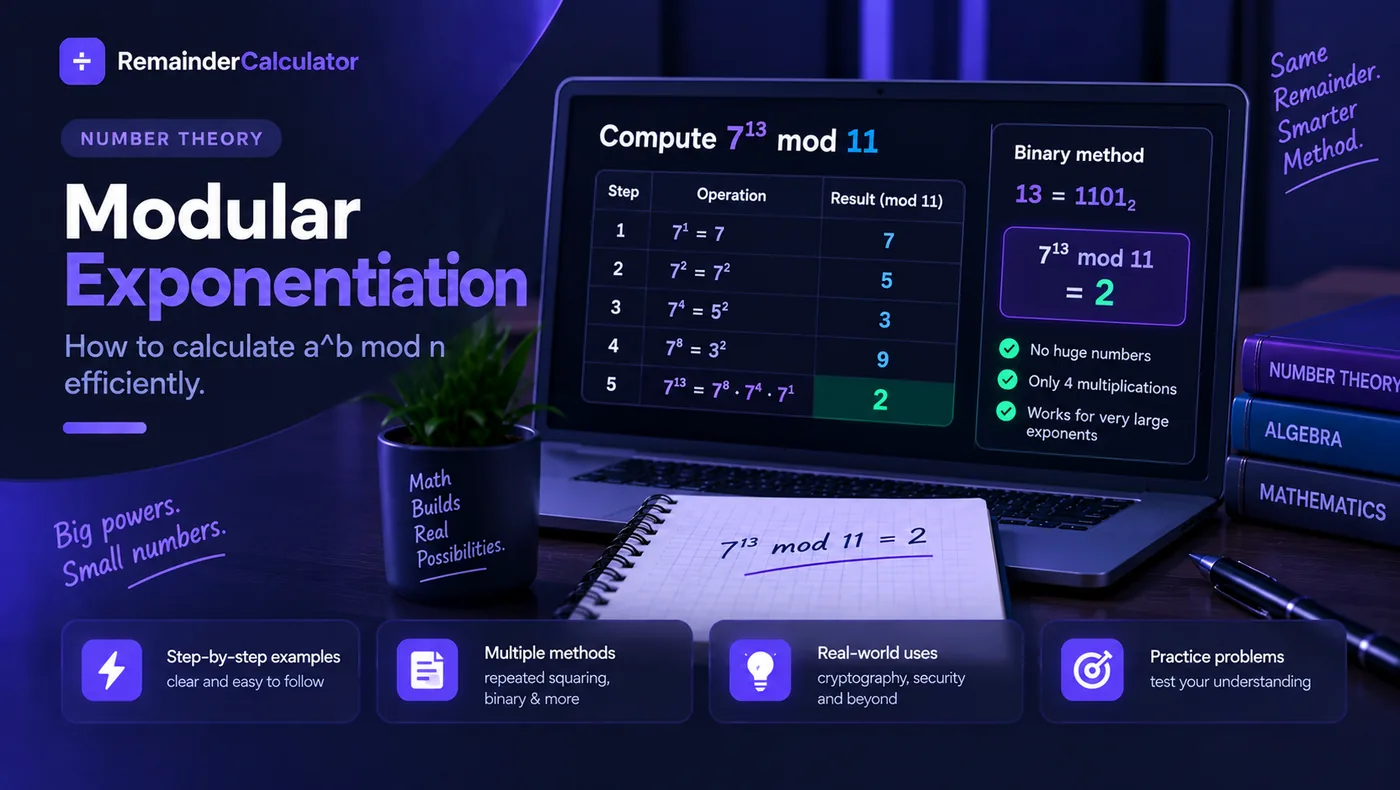
Modular Exponentiation: How to Calculate a^b mod n Efficiently
Compute a^b mod n without ever forming a^b. Reduce as you go, then use repeated squaring and the binary exponent, with full step tables and pseudocode.
Read More →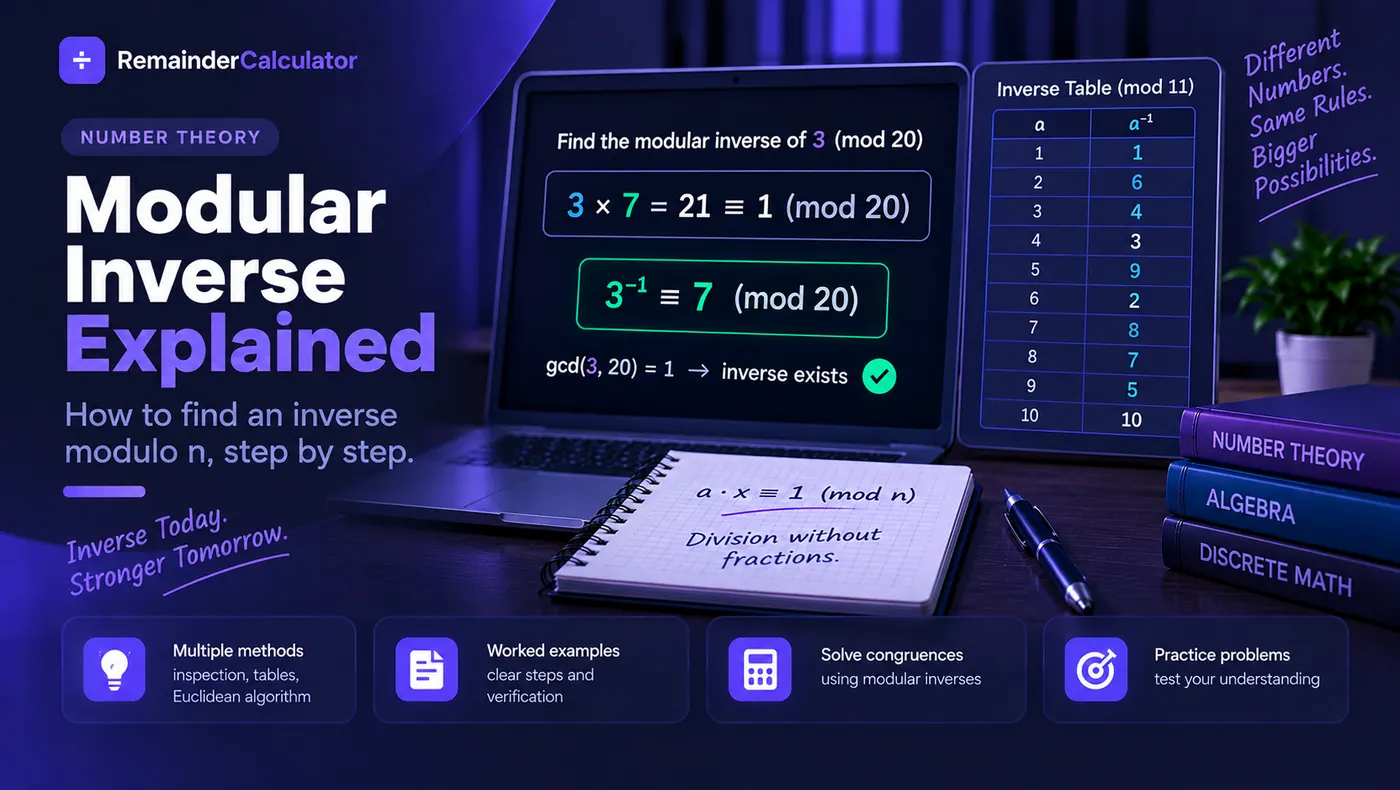
Modular Inverse Explained: How to Find an Inverse Modulo n
A modular inverse of a is the x with ax = 1 (mod n). When it exists, four ways to find it, an inverse table mod 11, and how to solve congruences with it.
Read More →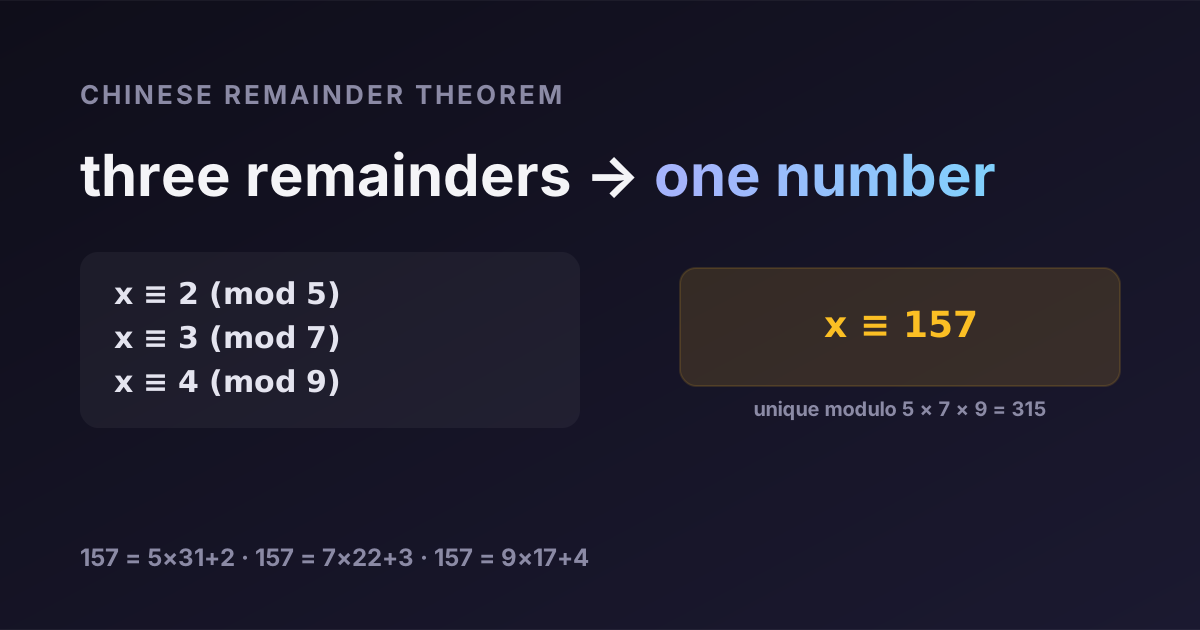
Chinese Remainder Theorem: Step-by-Step Examples and Solutions
Solve systems of congruences with the Chinese Remainder Theorem. The sieve, substitution and construction methods, worked step by step, plus non-coprime cases.
Read More →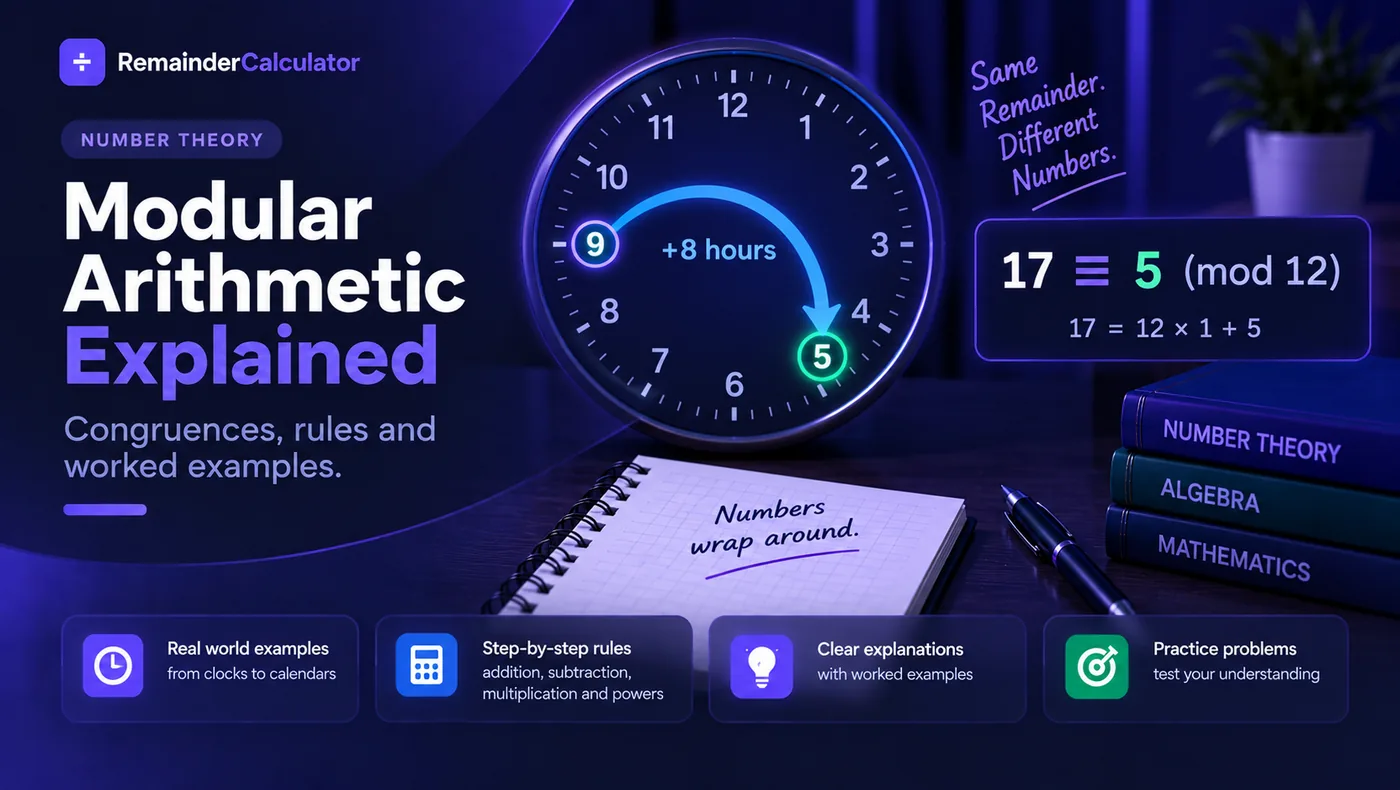
Modular Arithmetic Explained: Congruences, Rules & Examples
Modular arithmetic works with remainders instead of whole numbers. Congruence notation, residue classes, the rules for adding, multiplying and taking powers mod n.
Read More →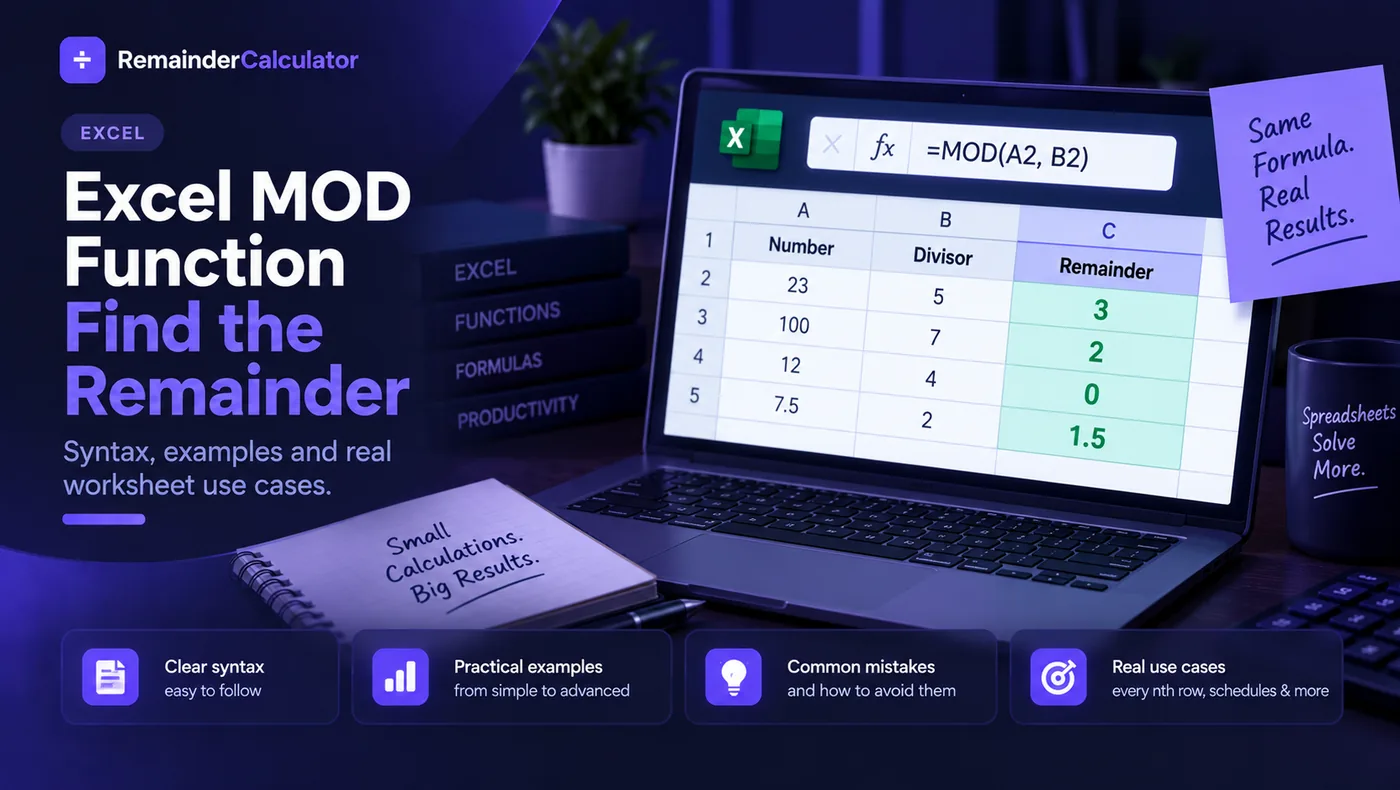
Excel MOD Function: How to Find the Remainder in Excel
MOD(number, divisor) returns the remainder in Excel and takes the sign of the divisor. Syntax, cell references, negative values, every nth row and MOD vs QUOTIENT.
Read More →
Division With Remainders Word Problems: 30 Worked Examples
30 worked division word problems with remainders, sorted by what the leftover means: keep it, round up, round down, or write it as a fraction or a decimal.
Read More →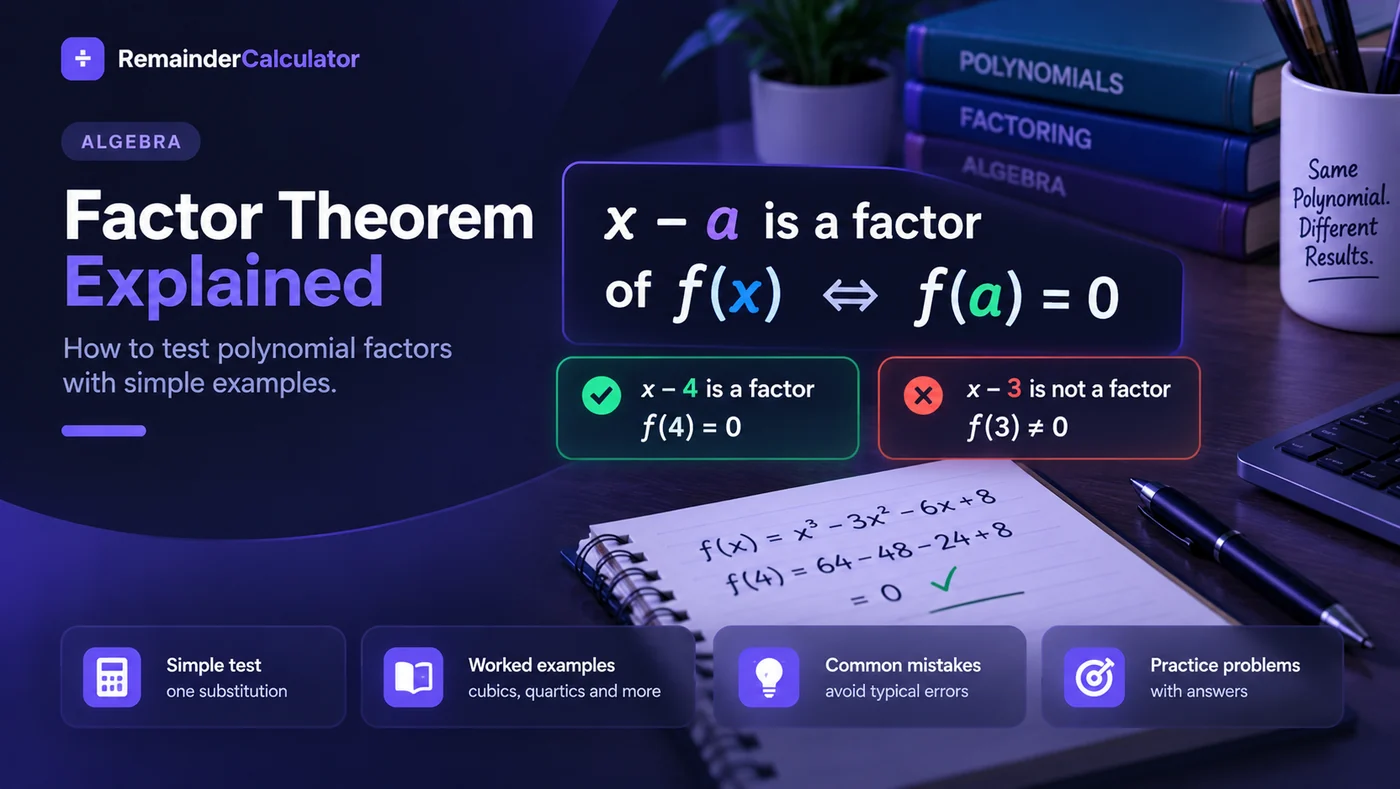
Factor Theorem Explained: How to Test Polynomial Factors
The Factor Theorem says x - a is a factor of f(x) exactly when f(a) = 0. How to test a factor in one substitution, factor cubics fully and find unknown coefficients.
Read More →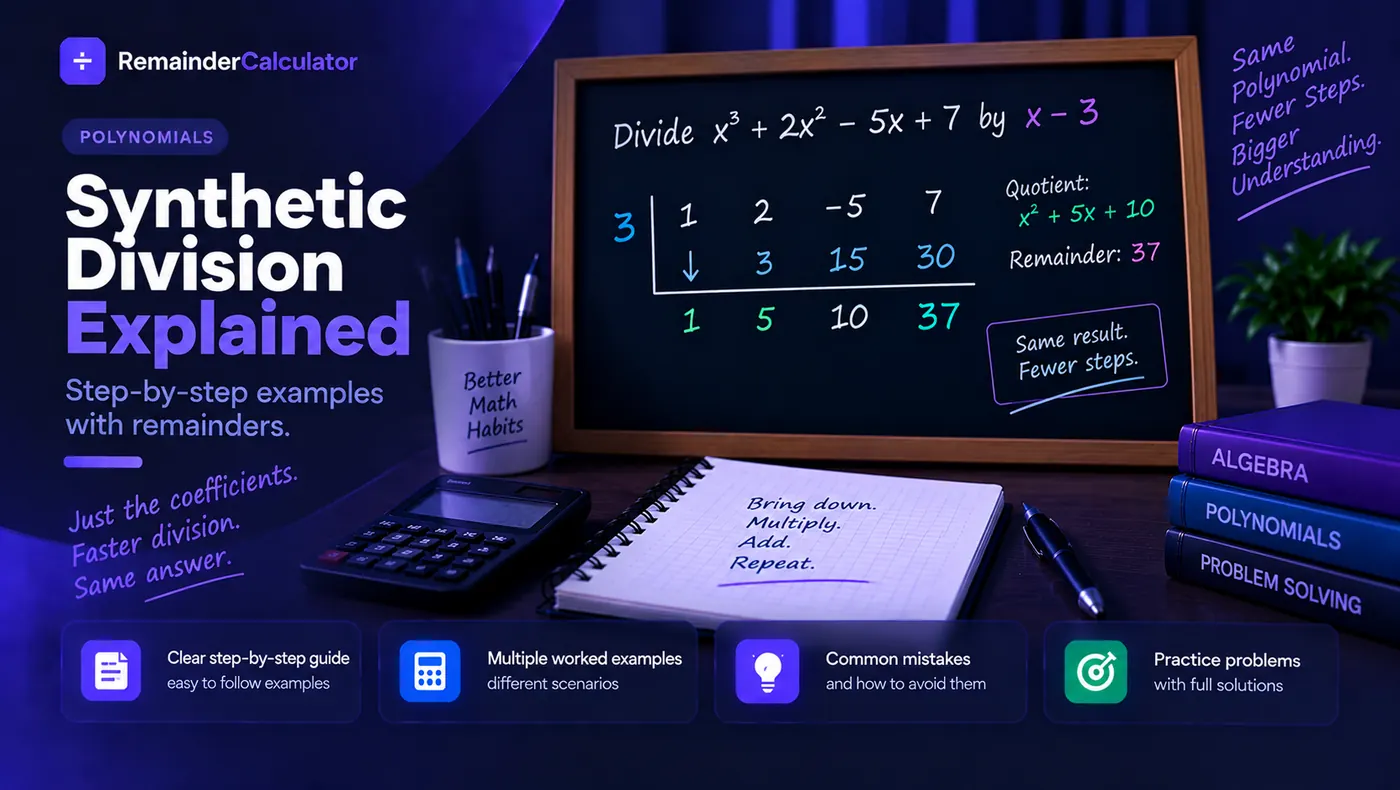
Synthetic Division With Remainders: Step-by-Step Examples
Synthetic division finds the quotient and remainder of a polynomial divided by x - a using only the coefficients. The setup, the multiply-add cycle and 6 examples.
Read More →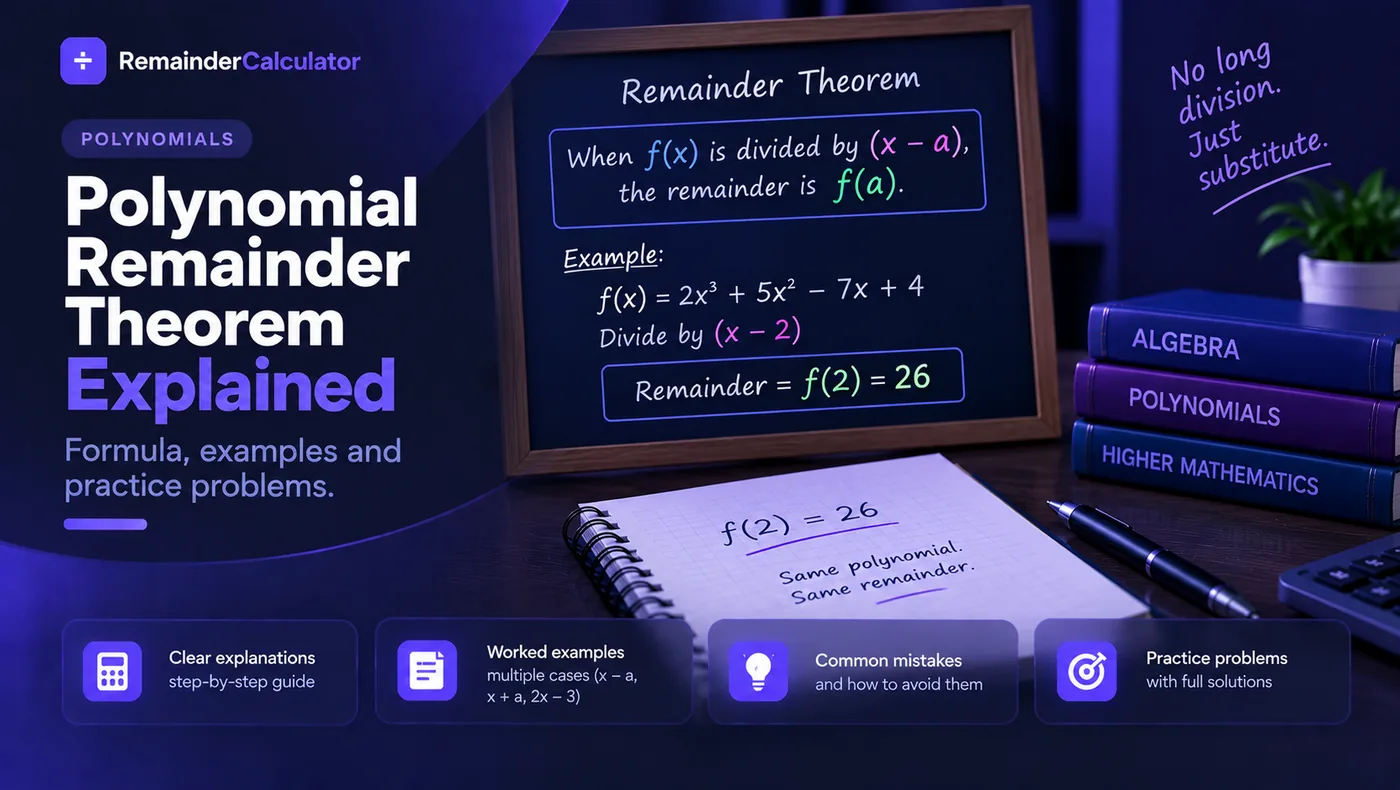
Polynomial Remainder Theorem Explained: Formula, Examples & Practice Problems
The Remainder Theorem says dividing f(x) by x - a leaves f(a). The formula, the proof in four lines, worked examples with x + a and 2x - 3, and 10 practice problems.
Read More →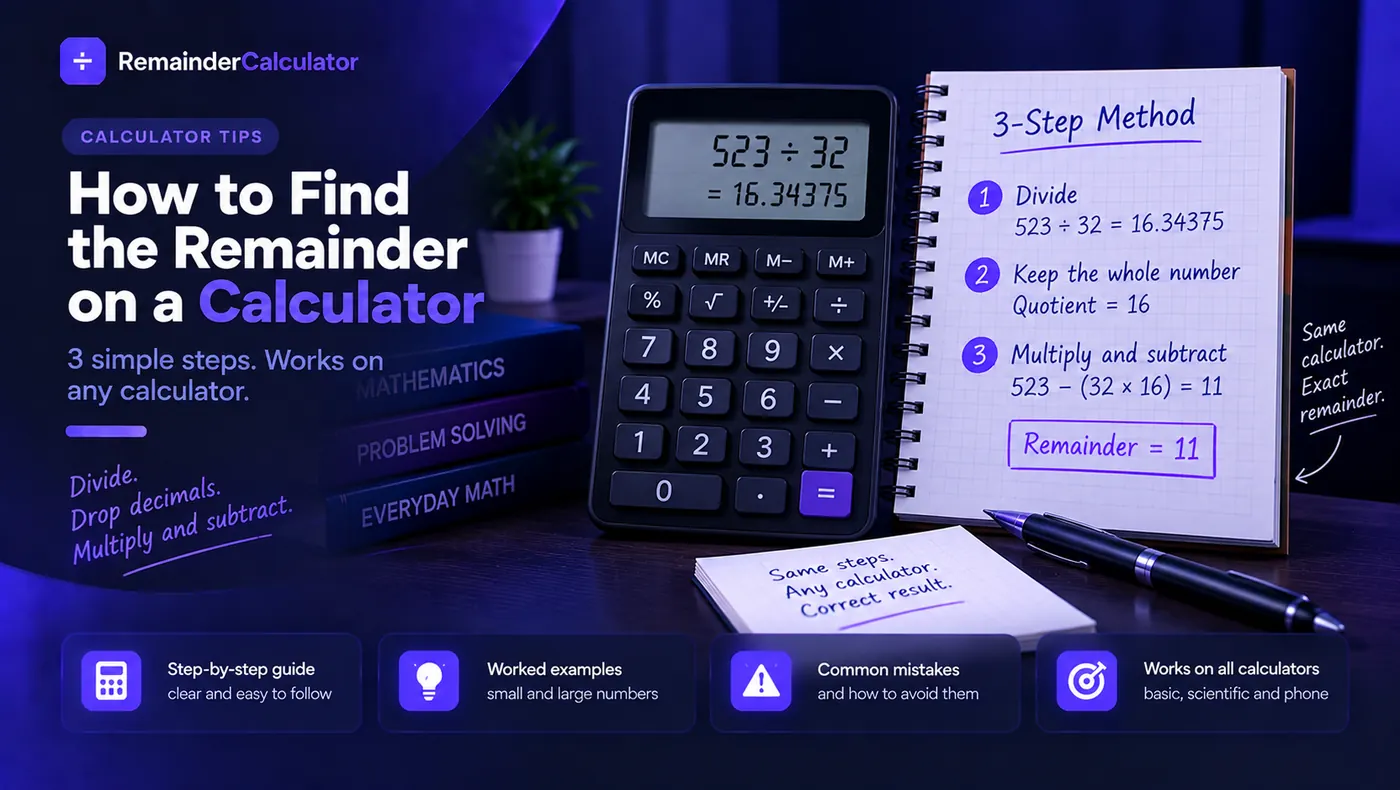
How to Find the Remainder on a Calculator: 3 Steps
Divide, drop the decimals, multiply back and subtract. How to get a remainder on a basic, scientific or phone calculator, and why rounding gives wrong answers.
Read More →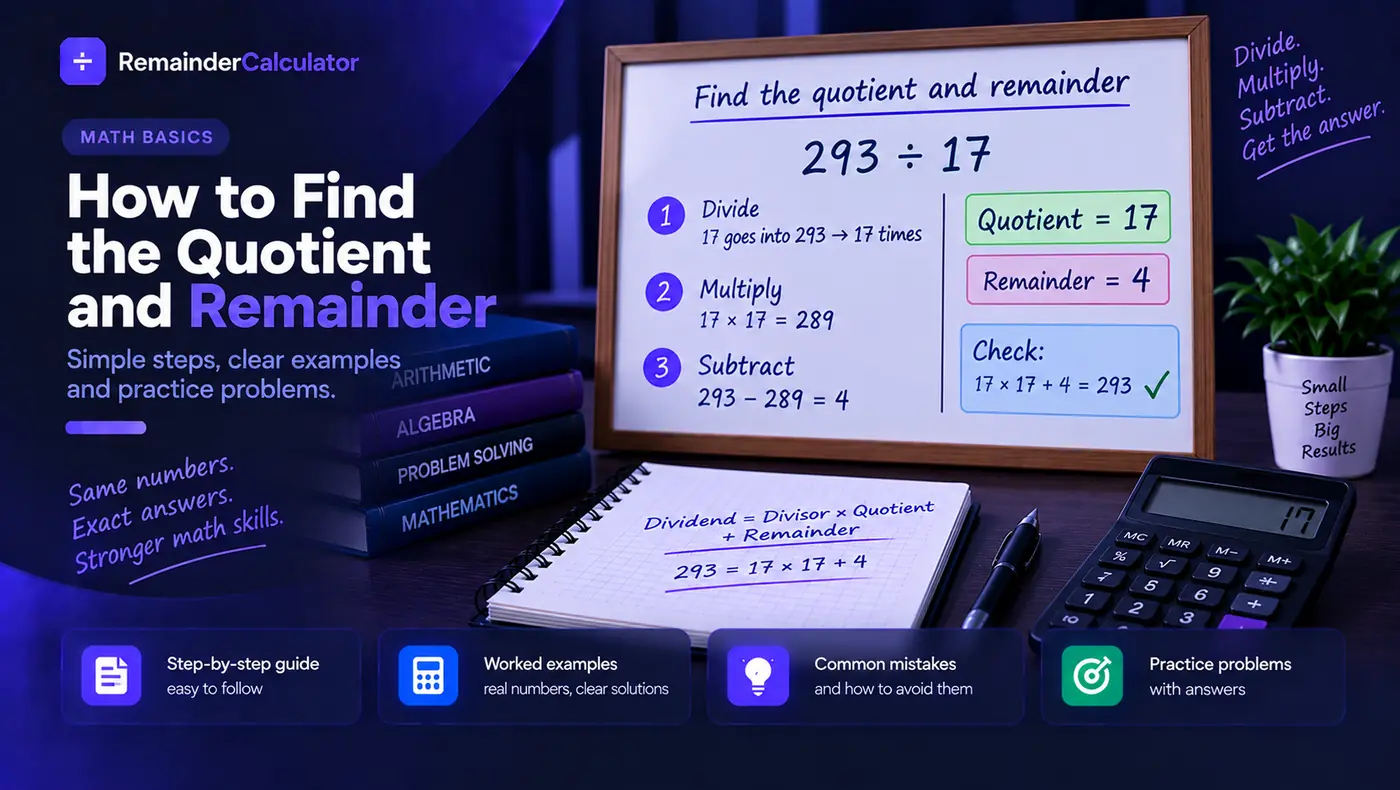
How to Find the Quotient and Remainder: Formula and Steps
Find the quotient and remainder in three steps using Dividend = Divisor × Quotient + Remainder. Worked examples, the nearest-multiple method and practice sums.
Read More →