Blog
Showing 13–22 of 22 posts
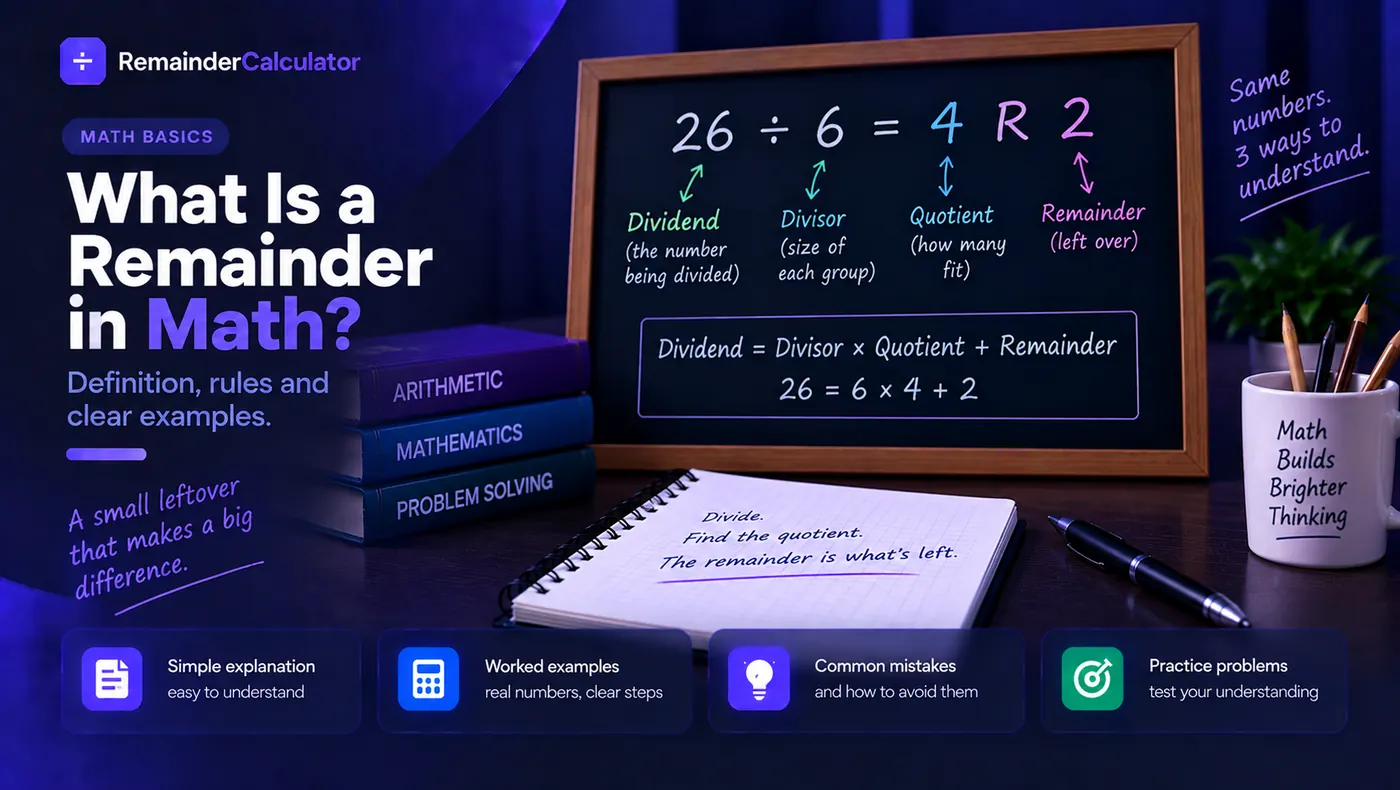
What Is a Remainder in Math? Definition, Rules and Examples
A remainder is the whole number left over when one number does not divide exactly into another. The definition, its two rules and how it fits the quotient.
Read More →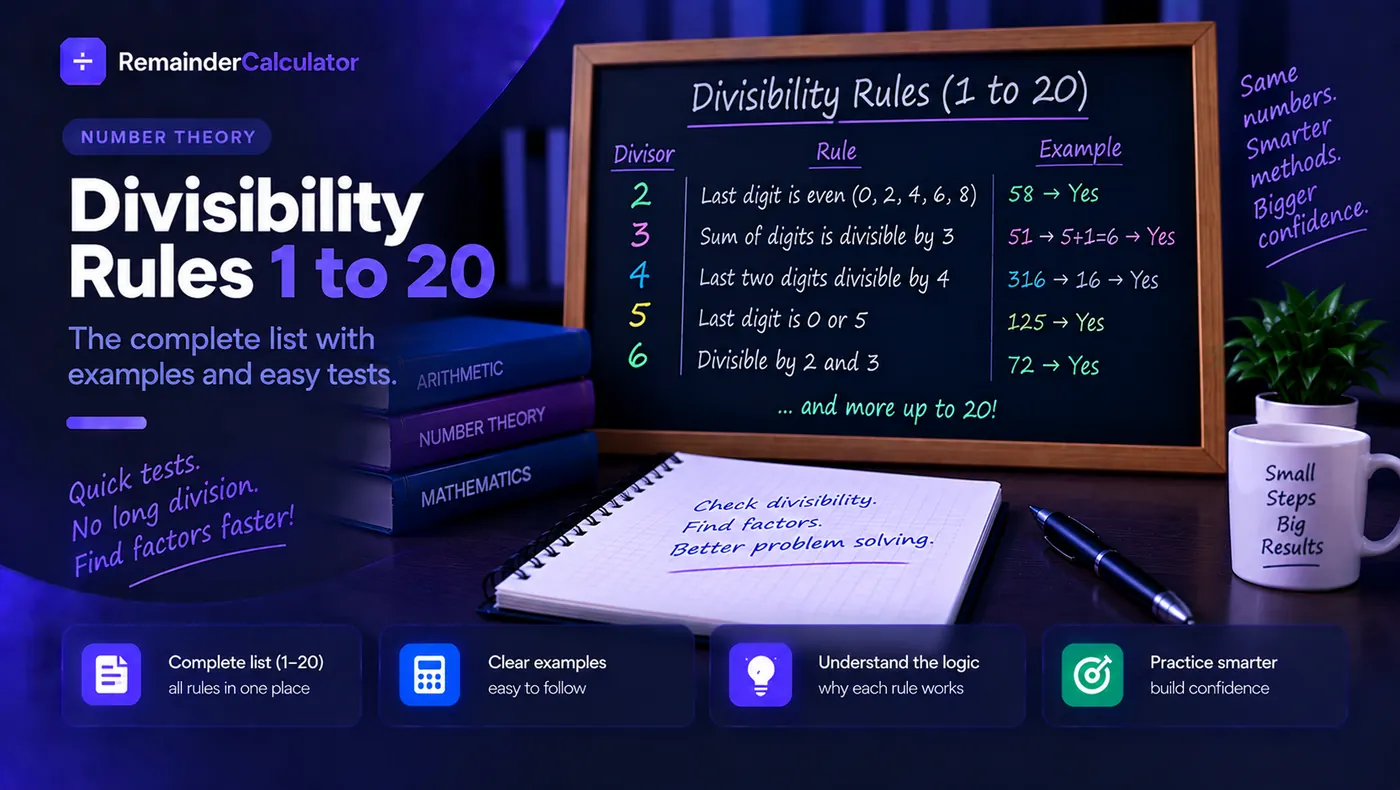
Divisibility Rules 1 to 20: The Complete List With Examples
Divisibility rules for 1 to 20 in one chart. The quick test for each divisor, why digit-sum and alternating-sum rules work, and how they reveal the remainder.
Read More →
How to Check if a Number Is Prime: Prime Test by Division
To check if a number is prime, test every divisor from 2 up to its square root for a remainder of 0. Learn trial division and the square root shortcut.
Read More →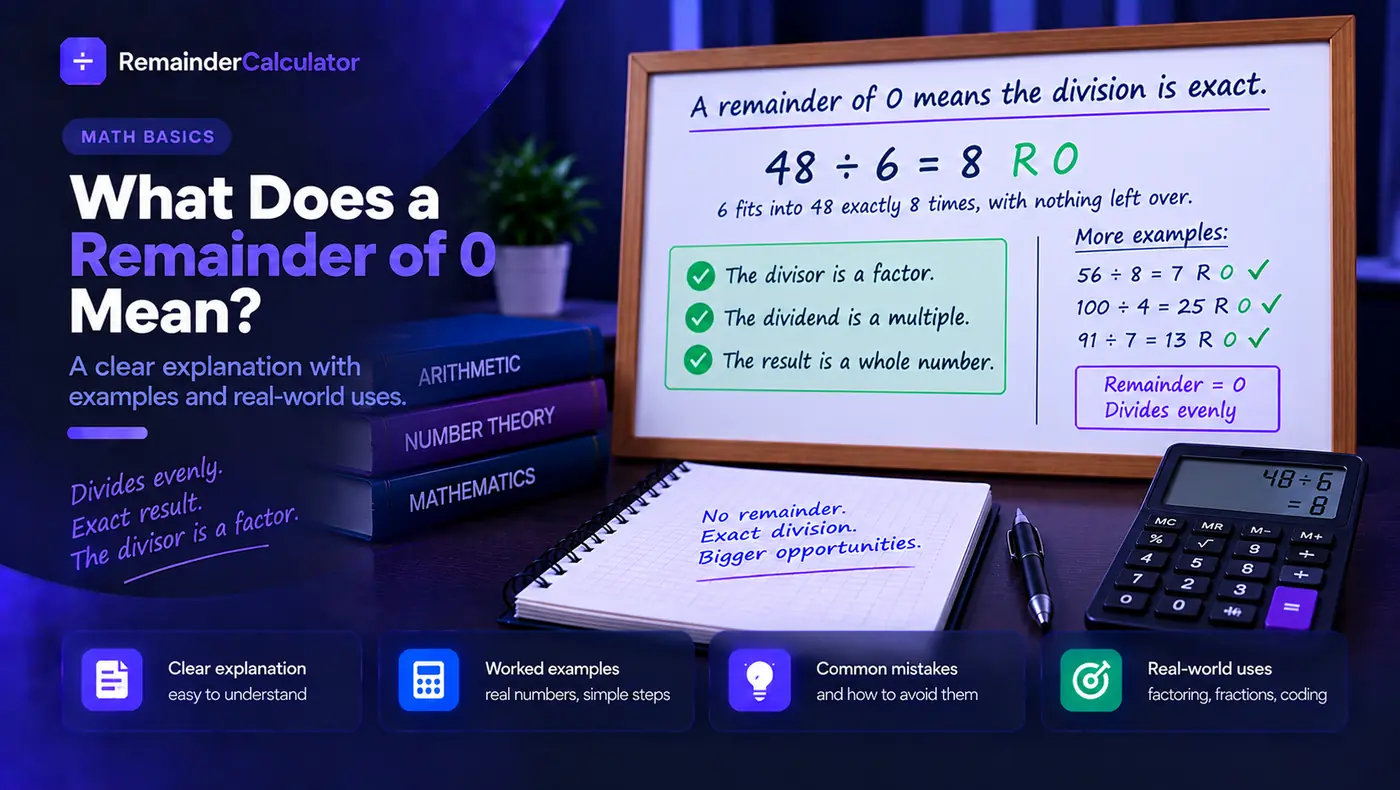
What Does a Remainder of 0 Mean? No Remainder Explained
A remainder of 0 means the dividend is exactly divisible by the divisor. Learn what no remainder means, why it makes the divisor a factor, and where it matters.
Read More →
Modulo in Python, JavaScript and C: A Language Comparison
The % operator behaves differently across languages. Compare modulo in Python, JavaScript, C and Java, with negative-number results and portable code patterns.
Read More →
Modulo Operator Explained: What Is Modulo and How Mod Works
The modulo operator returns the remainder of a division. Learn what modulo means, how mod works in code, its precedence and its negative-number behaviour.
Read More →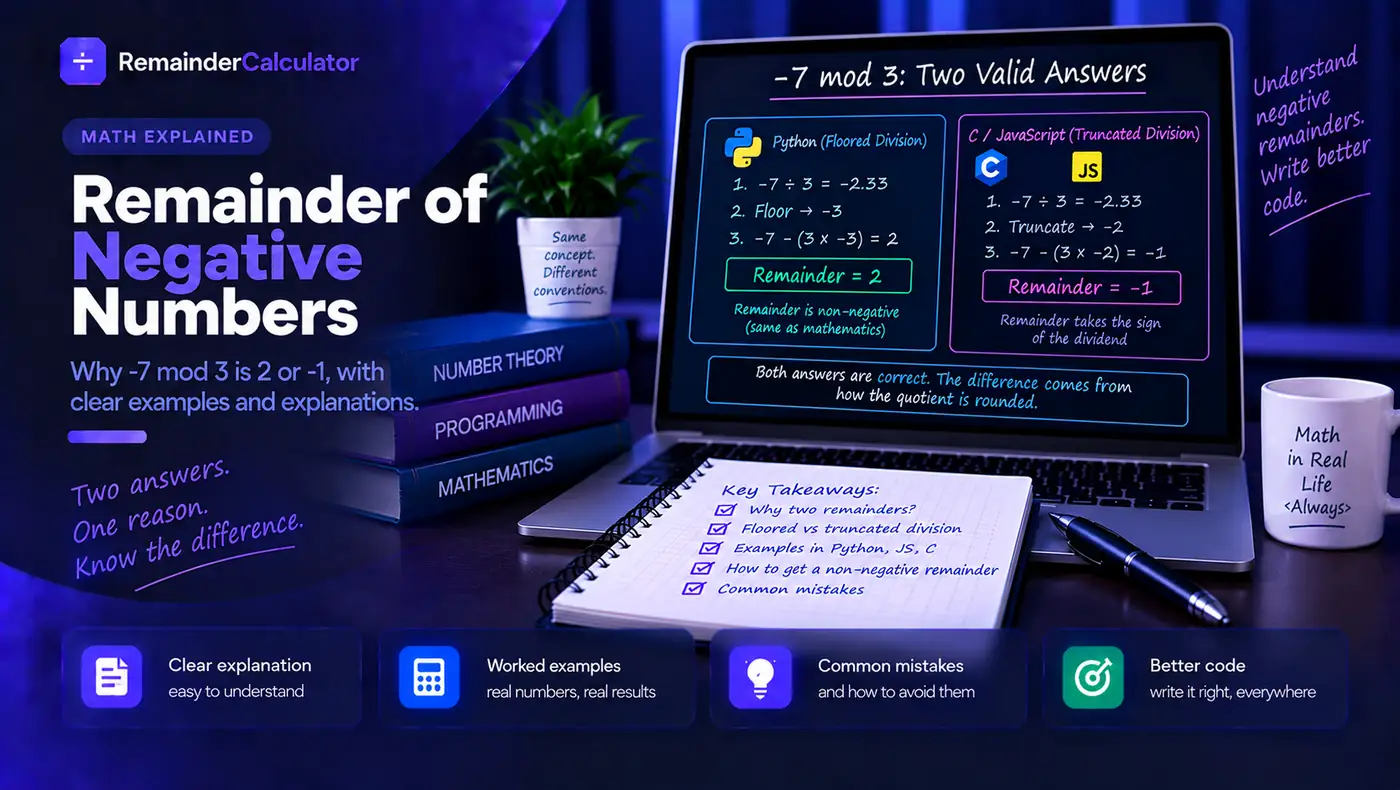
Remainder of Negative Numbers: Why -7 mod 3 Is 2 or -1
The remainder of a negative number has two valid answers. Learn why -7 mod 3 gives 2 in Python and -1 in C, and how floored and truncated division set the sign.
Read More →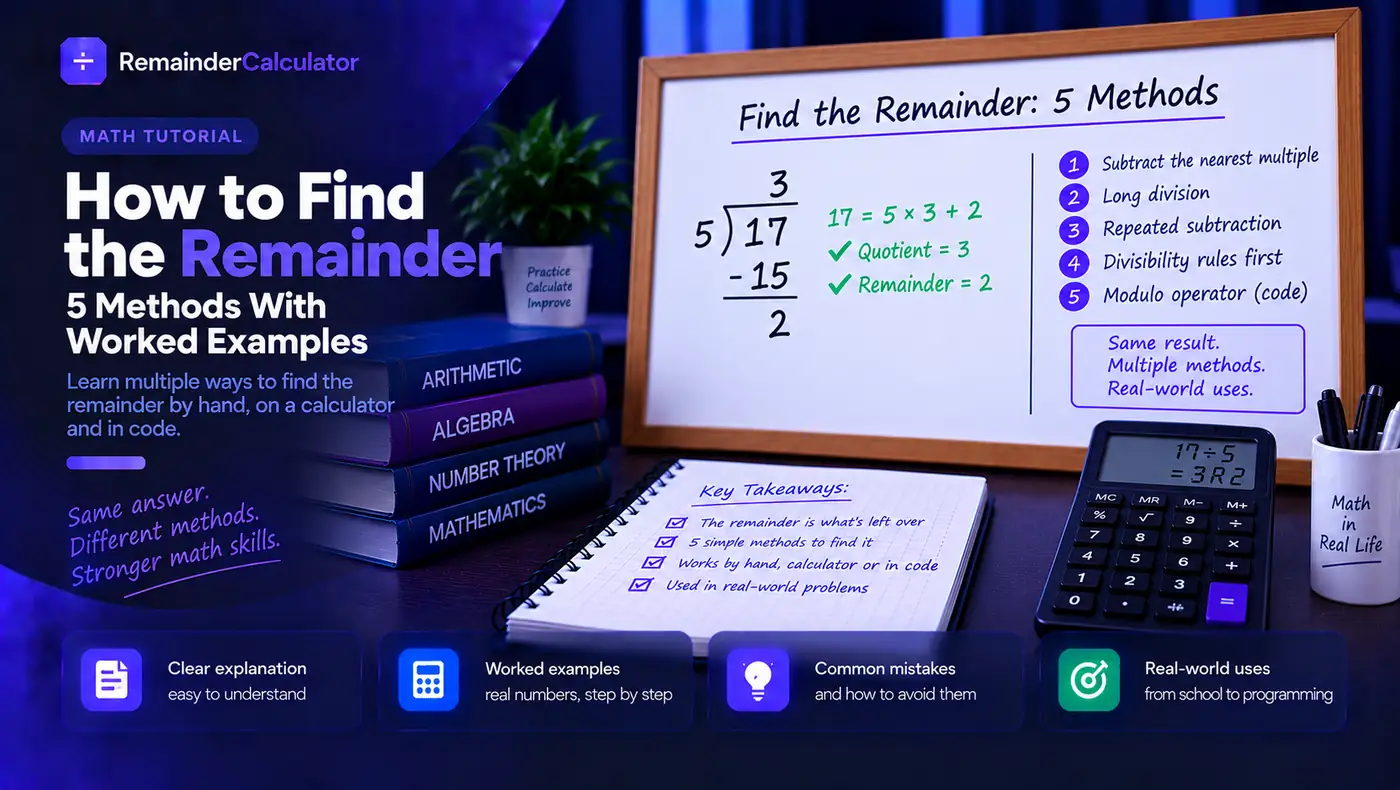
How to Find the Remainder: 5 Methods With Worked Examples
The remainder is what stays behind after division. Learn 5 methods to find it by hand, on a calculator and in code, with the formula and worked examples.
Read More →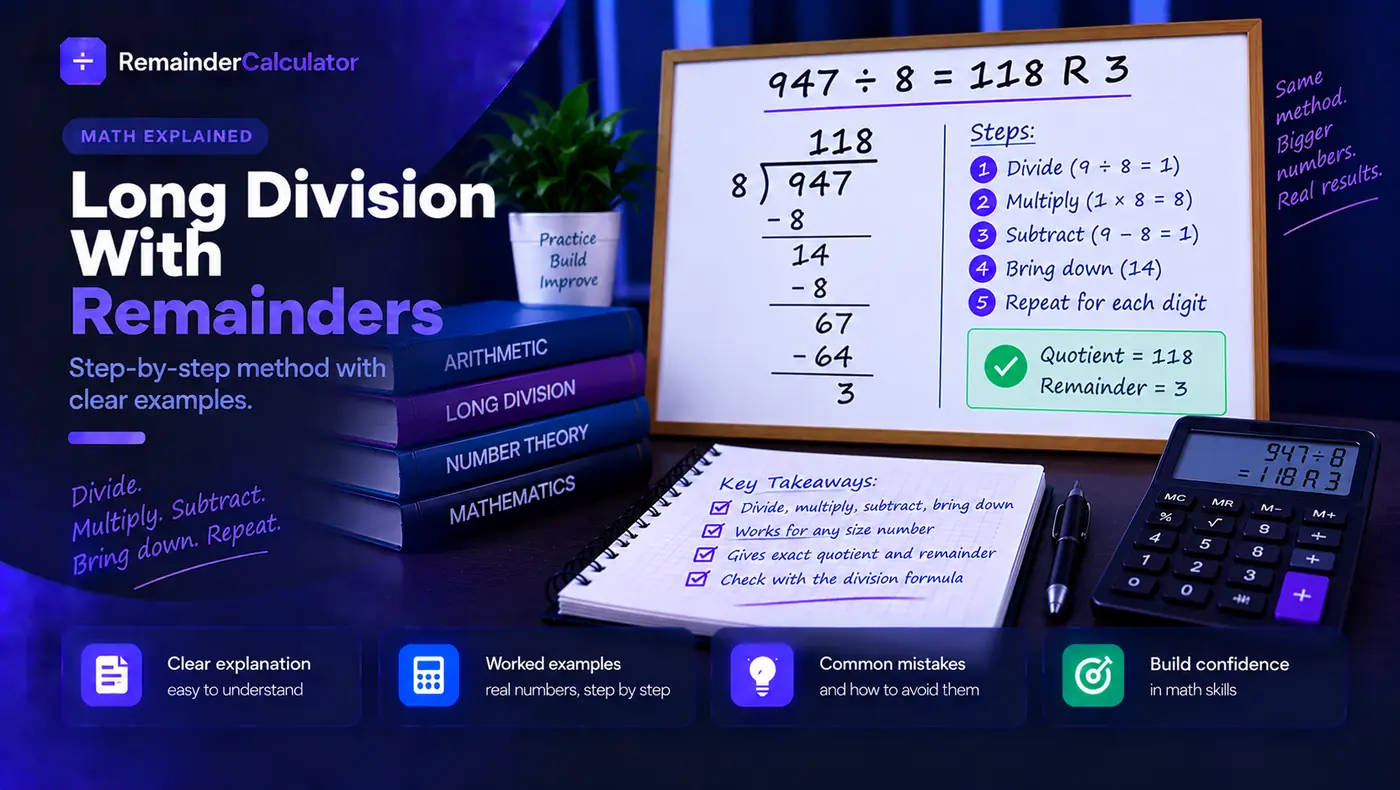
Long Division With Remainders: Step-by-Step Method
Long division with remainders solved digit by digit. Learn the divide-multiply-subtract-bring down cycle, handle internal zeros, and check every answer.
Read More →Remainder Shortcuts and Tricks: Find the Remainder Fast
Find the remainder quickly without long division. Learn the shortcuts for dividing by 2, 5, 9, 10 and 11, the power cycle trick and the bitwise method.
Read More →